Tuesday, January 26, 2016

Cool Beans

I believe in the power of heirloom seeds.  Although it may take a few growing seasons before some crops adapt to a new environment, if the gardener saves the best seed specimens for subsequent plantings, these smart plants will thrive in a variety of growing conditions, produce abundantly and develop resistance to pests.  At Heart & Sole Gardens, two bean varieties are excellent examples of how heirloom seeds acclimate to geographic areas.

Granny's Beans, Growing in 2015 from Pre-1985 Seed

For many years, my maternal grandmother, Lora Bolick Minton, grew a large vegetable garden and saved seeds from her plants.  Most of the seeds she planted were inherited from immigrant ancestors who brought them from Germany.  After my grandmother died, in 1986, my parents stored her seeds in their freezer and when I cultivated a large 2008 garden, they offered me the seeds.  I planted Granny's beans in 2009 and, even though these seeds were dormant for almost twenty-five years, the plants thrived and I harvested bushels of Mountaineer White Half Runner beans.  Despite the abundant yield, I made a terrible mistake.
Pickled Dilly Beans, A Favorite Family Treat
Because I love to grow a variety of plants and seed catalogs' colorful photographs and exotic descriptions entice me to order, my 2010 garden included several varieties of beans.  Unfortunately, I neglected to separate each type by a sufficient distance and hardworking pollinators carried pollen from blossom to blossom, resulting in seeds that, when planted in 2011, produced beans that were not true to type, but carried traits from many parents.  Although these "mutt" heirlooms were delicious, I resolved to maintain true seed for my grandmother's beans.
Good Friday Planting Restored Pure Seed Stock


Fortunately, I still had a few pre-1985 bean seeds stored in my freezer and I decided to plant them on Good Friday, a traditional planting day, for an extra measure of luck.  Though the seeds were at least thirty years old and April 3rd was early enough to flirt with killing frost danger, the seeds germinated well, produced strong vines and enough beans to replenish my true seed supply as well as plenty for pickling, canning and eating fresh.  
Ted's Butter Beans
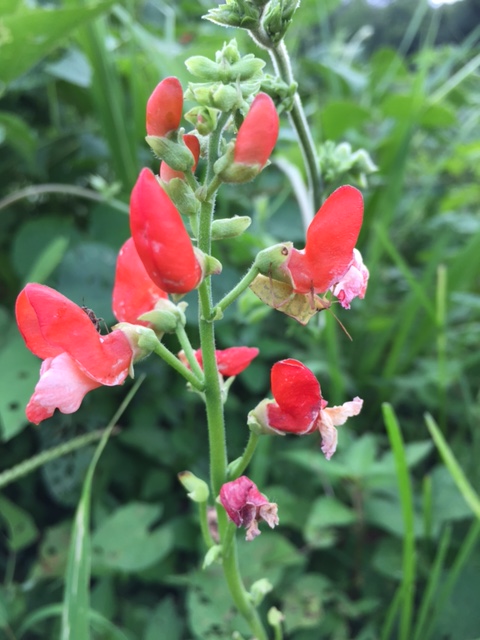
Another heirloom bean I love is one that Cranberry, NC, resident and lifelong farmer, Ted Hoilman, shared with me and friend, Kim Barnhardt.  Generations of Ted's family grew these heirlooms and the colors are beautiful, the beans large and the flavor delicious.  Since these seeds are acclimated to a cooler growing environment, they thrive in Kim's mountain garden, but struggle in my Caldwell County climate.  After saving a small amount of seeds for the past few years, 2015's crop seems to be well adapted to a new growing region and, with good growing conditions, should produce well for 2016.  Learning from past mistakes, I now separate beans at Heart & Sole, with hope to pass true seed to the next generation of family gardeners.  
Beautiful Butter Bean Blossoms

When I was a child, my grandmother picked bushels of green beans every summer.  I remember the snap, snap of beans as my grandmother, mother and aunt, prepared them for canning and the distinctive fragrance of cooking beans wafting from the kitchen.  Our family ate canned green beans several times each week and I recall a trip to the coast when we made green bean sandwiches from the jars we packed for the trek.  Although I use my canned beans for many recipes, the following is one that is a traditional family preparation.  Now that I think about it, green bean sandwiches would be fun to try as an adult . . .

Southern Style Green Beans
*I remember beans from my childhood were cooked until almost mush, but for optimum flavor and texture, do not overcook.

3 slices smoked pork side meat (or thick bacon)
1 tablespoon vegetable oil (or olive oil)
1 medium onion, diced
2 quarts canned green beans or 3-4 pounds fresh snap beans, strings removed, washed and cut or broken to 2-3 inch pieces

Heat oil in a large Dutch oven and slowly cook meat until fat renders.  Remove meat or leave in pot.
Add onion and stir to coat with oil/fat.  Cook over low heat until tender, about 4 minutes.
Add beans and enough water to just cover.
Add 1/2 teaspoon sea salt, few grinds of black pepper, 1/4 teaspoon onion granules and 1/4 teaspoon garlic granules.  
For a spicy kick, add a pinch of red pepper flakes.
Place lid on pot and cook until beans are tender.

*Vegetarians may omit pork and increase oil to 2 tablespoons.


Sunday, January 17, 2016

What Lies Beneath? Baby Carrots!

As a four-year-old child, I watched my father take the frilly green leaves in his hand and pull.  To my astonishment, a long, bright orange vegetable emerged from the soil.  Although that first experience with pulling carrots was many years ago, the tantalizing excitement of discovery still exists when I harvest those root vegetables.  

Colorful Baby Carrots
Carrots are a satisfying crop to grow.  With good germination and few pests, carrots thrive in cool weather and yield both spring and fall harvests.  Carrots grow best in loose soil and raised rows, created with a hiller tractor attachment, are ideal for root development.  Of course, it also works to use a rake or hoe to make a raised row, with the added benefit of an ab workout!  Sow carrot seeds along the row top and lightly cover with soil, brushing hands across the seeds or using a push broom for larger areas and keep soil lightly moist.  When seeds germinate, in about 2-3 weeks, allow carrots to grow to a height of approximately 2-3 inches before thinning.  Use scissors to snip tops or gently pull smaller plants to allow remaining roots to grow straight.  After plants reach a height of about 4-5 inches, thin a second time.  Thinning is a stressful job and requires one to channel an inner Morticia.  After all, it is not easy to decide who will live and who will die . . .
 
If carrots are not thinned, roots create interesting "dancers"
During a recent trip to Charleston, SC, we visited several popular restaurants and enjoyed delicious meals, including a to-die-for burger at Husk, but one simple dish captured the essence of one of my favorite vegetables.  FIG (Food is Good), located in Downtown Charleston, led by James Beard Foundation's 2014 Best Chef Southeast, James Stanhope, serves a simple salad with complex flavor and interesting texture. Listed on the menu as "Spiced and Roasted Carrot Salad: greek yogurt, pine nuts, mint," this delightful concoction of baby carrots, nuts and tiny fresh mint leaves lingered in my taste memory.  Since I happen to have a nice row of colorful baby carrots at Heart & Sole, I decided to try to recreate this salad.  Excellent as a side dish and hearty enough for a vegetarian entree, grab some baby carrots and try this recipe.  If you want to experience the joy of pulling surprises from the ground, make plans now to plant a row of heirlooms for spring harvest.  


Roasted Spiced Baby Carrots with Greek Yogurt Dressing

Lightly toast 1/3 cup pine nuts until fragrant, set aside to cool

For the dressing, in a small bowl, whisk together 1/2 cup Greek yogurt, 1 tablespoon fresh lemon juice, 1 teaspoon white vinegar (I used homemade, flavored with Thai herbs), 1/4 cup good quality olive oil, 1/2 to 1 teaspoon fresh minced dill, few grinds black pepper and 1/2 teaspoon salt.  Cover bowl and refrigerate until ready to serve.


1/2 pound baby carrots, scrubbed and greens trimmed (reserve tops for another use)
1 tablespoon good quality olive oil
1/2 teaspoon salt (I used French Grey Sea Salt)
Several grinds black pepper
1/4 teaspoon ground ginger
1/4 teaspoon ground nutmeg (for best results, grind from whole)

Place carrots in a ziplock bag and add oil and spices.  Toss to combine and refrigerate for about an hour or so.
Roast carrots until fork tender
Place carrots in a small roasting pan and roast in a preheated 450 degree oven until fork tender, stirring every five minutes, until carrots are fork tender, about 20-30 minutes.  Do not overcook carrots; they should retain a bit of crunch.

In a large bowl, combine carrots with nuts.
Serve with dressing and scatter fresh mint leaves over top.


Thursday, January 7, 2016

Five Growing Trends for 2016

Here we go again.  The New Year's Eve confetti is scarcely swept away before it seems every marketing expert is primed to direct our attention to what is new and different for 2016 lives.  The "it" colors for this year?  Pink and blue. . . sorry, but the 1980s combo will not reappear in my home.  That 1986 mauve dining room, a shade too close to Pepto-Bismol for comfort, is best left to the young and impressionable.  

Colorful  Blossoms Make Beautiful Salad

It's time to make plans for what to plant, where to plant and how to plant in the 2016 garden and, even for die-hard growers who stick to a strict annual plan, there are enticing possibilities available.  While I am certainly no expert and my trendy selections are based entirely on unscientific sources like farmer's markets, my own experiments and chef/restaurant order requests, the following list includes plants I think will prove to be popular in 2016 gardens.  So, visit your local hardware and gardening store and purchase seeds or plants.  Even if you find something you grow to be unappealing, at least you can eat it.  Unlike that queasy dining room. . .
 
Okra Blossoms and Pods, Tasty Edibles

*Edible Flowers
Most fruits and vegetables produce blossoms that are both beautiful and delicious.  Violas and nasturtiums are popular salad ingredients, but vegetable blooms like beans, okra and squash are also tasty.  In the herb bed, grow borage for deep blue star-like blossoms that taste like cucumber or garlic and chives for pink, onion flavor.  Perhaps pink and blue can be garden trendy for 2016?

*Watermelon 
Forget those mealy, almost tasteless orbs offered by supermarkets from early fall until late spring.  Sure, it's convenient to buy a melon without seeds, but for juicy, sweet flesh that slathers the face, grow an heirloom variety. Recent rumors that the Bradford watermelon, a popular 1800s heirloom, may reappear, spur me to search for seeds, but the Moon and Stars melon, with beautiful dark green skin spotted with yellow orbs and deep red flesh, is an excellent choice for backyard gardens. 
Moon & Stars Watermelons are Distinctive and Delicious
*Herbs

Any supermarket shopper who purchases fresh herbs, tiny snippets encased in small plastic packages, has doubtless suffered sticker shock at the price.  One of the easiest plants to grow, most herb varieties grow in poor soil and require little water.  As long as full sun is available, herb plants produce more than adequate amounts of leaves and blossoms and the excess can be easily dried or frozen for later use.  In addition to annuals like basil, plant rosemary, sage, oregano and thyme for year-round harvest.  For our area, rosemary is a particularly satisfying plant since it blooms during cold weather and the dainty blue flowers are a welcome sight in mostly-dormant gardens.  
Borage is a perfect container plant
*Greens

Yes, King Kale has enjoyed a long reign as the most popular green, with good reason, but other greens, with delightful flavor and nutritional punch, deserve space in the 2016 garden.  Bok Choy, Malabar Spinach and Mache are good choices and Arugula, or Rocket, as the Brits know it, is a hardy salad green that produces abundant leaves, creamy blossoms and seeds that are also delicious.  The flavor of home-grown arugula is far superior to supermarket wares, as are all fresh greens.
Move over, Kale, and make room for Bok Choy

*Popcorn
Industrially processed popcorn receives a great deal of negative press, but for those who crave a salty crunch and rich flavor, try growing an heirloom variety.  Cherokee Long Ear boasts beautifully colored kernels and was an abundant producer in my 2015 garden.  Strawberry, Dakota Black and Dynamite are other good choices.  Note:  Popcorn will "cross" with other corn varieties, so plant popcorn after sweet corn ears form or separate plantings for best results. 
Allow popcorn ears to dry before harvest
For 2016 and beyond, Happy Gardening!


Thursday, December 24, 2015

A Special Gift

There's something about a handwritten recipe.  I wrote about my grandmother's handwritten recipes in a seedtales blog, Bamboo Pickles, Family Recipes and Friendship and many readers contacted me to express love for handwritten recipes.   Perhaps it is a visceral connection to favorite foods or maybe, in today's digital world, we appreciate the time and effort it takes to write by hand, but for some reason, handwritten recipes become treasured talismans for a lot of us home cooks.

My grandmother gave me her collection of recipes before she died

My home really should be better organized by now; after all, I retired from my public school educator job over four years ago.  There is really no excuse for storing boxes that have remained unopened for years.  Recently, I entered Purge Mode and tossed, donated and sorted an area I neglected for too long.  It was there I discovered treasure. . . 
Handwritten Recipes, Including Vidalia Onion Pie

Not the kind of treasure most people would value, this envelope filled with recipes, many handwritten, enticed me to abandon my cleaning project and read.  When I unfolded a thin, yellowed sheet of paper, spotted with what looked to be cooking oil, I sighed.  It was my sister-in-law's prized Vidalia Onion Pie recipe and it was recorded in her handwriting.
Nan with Clark
Nancy Barlowe Ingram, Nan, to those who knew and loved her, was the mastermind behind hunting for pirate treasure at the coast, organizing Easter egg hunts and packing for hundreds of Sunday afternoon picnics at Price Park, in Blowing Rock.  A beloved kindergarten teacher, Nan knew how to make any activity fun and exciting and when she died, at age 43, her death left a void in our family gatherings.  Although Nan created many delicious dishes, her Vidalia Onion Pie was the family favorite and we always include it in the annual Thanksgiving celebration.  


When I saw the recipe, I immediately knew who should have it.  My son, Clark, frequently names Aunt Nancy's Vidalia Onion Pie as his favorite Thanksgiving dish and since he became the official host for a large gathering of friends and family for that holiday, it is only fitting he should own the recipe.  Encased in a shadowbox, in case he wants to hold it, the recipe is wrapped and lying beneath my Christmas tree.  By the time he reads this, Clark will have opened the gift and I know it will be one he loves.

My holiday wish for each reader is that you are able to share a special gift with someone.  Whether it is something you make with your own hands, purchase at a store or includes that most valuable commodity of time shared, I hope your gift is as precious to you as to the one who receives it.

Merry Christmas!

Tuesday, December 22, 2015

Pass the Black Peanuts

As the year draws to a close, it is a good time to reflect about gardening successes and failures.  2015's heirloom tomato crop was abundant at Heart & Sole Gardens, but the potato harvest was poor.  Peppers produced well, but deer and groundhogs ate more okra than we did.  Fortunately, one special plant thrived and generated enough seeds to share with other NC farmers.  Let's hear that cheer for black peanuts, also known as the North Carolina Peanut!

The North Carolina Black Peanut germinates quickly
It is not often we receive an opportunity to revive an agriculture crop.  With chemical companies' seed wares dominating the shelves of most big box stores, savvy gardeners rely on local businesses, like Renfrow Hardware, in Matthews, NC, or online resources to supply heirloom seed.  Fortunately, my cousin, Ruth Bolick, saved black peanut seeds for about thirty years and, this spring, she shared some with me.  For more of that story, see the earlier blog: Heirloom Seeds by Mail
Richard prepares a row for 25 Black Peanut seeds
That earlier blog post served as an introduction to Gordon Schronce, a lifelong Iron Station gardener who provides seeds, including the Carolina Black Peanut, to Southern Exposure Seed Exchange  Gordon's son, Arty, writes a lovely gardening blog for The Georgia Department of Agriculture and, for souls who long for spring planting season, a visit to Arty's Garden is a pleasant way to survive cold winter days. 
Black Peanuts drying in my dining room 
On May 16th, Richard and I planted 25 Black Peanut seeds at H&S.  For insurance, I also planted a few in containers at my home, in case pests attacked the farm plants.  After quickly germinating and thriving throughout the summer, the peanut plants were ready for harvest in early October.  I spread them on a large outside table to dry, but I forgot about the Titmouse bird and how he loves peanuts more than any other food.  When I saw that tiny winged creature attacking the harvest, I moved the peanuts to my dining room where they safely remained for a few weeks. 
Inferior for seed, these Black Peanuts are delicious to eat
Although I planted less than forty Black Peanut seeds, the plants were extremely productive and I sorted the best specimens for next year's seed, saving the remainder to use as food.  With only a cup of Black Peanuts, I decided to use a special recipe, a handwritten one from my grandmother, Lora Bolick Minton. 
Granny's Recipe for Sugar-Coated Peanuts 
After dissolving 1/4 cup sugar in 1/2 cup water over low heat, I added peanuts and stirred the mixture until the syrup coated the peanuts, leaving no liquid in the pot.  Pouring the mixture on a parchment paper lined jelly roll pan, the peanuts baked for 30 minutes in a 300 degree oven, with a good stir every five minutes. 
Black Peanuts in syrup look like blueberries 
In this season of sharing, the candied Black Peanuts will go to Ruth, a small token of how special her seed gift was.  As for the seeds, after reserving some for Heart & Sole's 2016 season, the rest will go to local farmers like Shelby's Jamie Swofford, Concord's Brad Hinckley and others.  A limited amount is also available at Renfrow Hardware, in Matthews.  With a concerted effort, perhaps the North Carolina Peanut will be available at local farmer's markets next fall and we can all celebrate this delicious flavor. 
Candied Black Peanuts

Saturday, December 12, 2015

The Sexy Garden

"YOO-Hoo!"  "Over here, Big Guy!"  "Look what I have!"  The catcalls are almost audible to human ears.  I am pretty sure I once heard a Mae West impersonator say, "Is that a pistil in your pocket?"  For those too young to know Mae West, Google her.  For those who think "pistil" is misspelled, read on.  

Working bee kicks smaller pollinator away from the pistil
Humans seem to think we have a monopoly on sex and maybe that is because it is a bit unnerving to think of food as being someone's offspring.  Not just animals we eat, but plants we consume are results of a sexual act.  Fruits and vegetables, rooted to the ground and unable to move, depend upon help to procreate and their efforts to entice pollinators can be pretty blatant.  Take summer squash, for example . . . 
Female squash blossom, inspiration for artists

Cucurbit family members, including summer squash, cucumbers, gourds, and pumpkins produce beautiful blossoms that attract pollinators to gather pollen.  As honeybees, squash bees and other winged insects travel from male to female blossoms, the plant receives help it needs to set fruit.  Male squash blossoms boast a smaller stamen, or pistil, than females and only female blossoms produce fruit.  Fully mature squash contain seeds that produce plants the following year, completing a generational life cycle.  
Successfully pollinated squash set fruit

All goes well for heirloom seed savers, unless different Cucurbit species grow in close proximity.  You see, Cucurbits will use pollen from other family members, producing offspring in future generations that are unlike the parents.  For this reason, gardeners who wish to save "pure" seed only grow a particular Cucurbit species or else separate those promiscuous plants. 
Male on left produces pollen for the female, right, that yields fruit
When I inherited my grandmother's heirloom squash seeds, it was like having a part of her back with me when I harvested zucchini, patty pan, crook neck and straight neck varieties.  A few years ago, seed catalogs arrived in my mailbox and the breathtakingly beautiful photographs of squash enticed me to try some new seeds.  Throwing caution to the wind, in the same field, I planted a colorful menagerie of about twenty different summer squash species.  With an abundant harvest, I saved seeds from the best fruit and found, the following year, the new plants produced some of the oddest looking squash I ever saw.  The taste was delicious, but there was hardly a single fruit that contained pure traits. 

Cross-pollinated heirloom squash fruit
I did not plant summer squash at Heart & Sole in 2015.  Although I grew some of my grandmother's crook necks at my home, for seed, the entire farm crop generated from those cross-pollinated fruits, left in the field from last year. As I tallied statistics a few weeks ago, I was astounded at the squash results.  Volunteer summer squash produced fruit from early June until early October and the total yield was over 600 pounds.  Not only were these Crazy Cucurbits fertile, but very successful in their enticement efforts.  Mae West would be proud . . .

More examples of cross-pollination

Wednesday, December 2, 2015

When Caring for Environment, Individual Actions Matter

I guess you could say I was complacent.  Lulled into a false sense of security.  Off guard.  Whatever you want to say about my lack of vigilance, suffice to say, I paid a price.  On July 22, 2015, despite warning signs I purchased and posted beside the highway that borders my farm, NCDOT workers sprayed herbicide chemicals along the highway guardrails and on plants and trees that border those eight acres.  By the time browned foliage and dropping leaves announced plant death, the damage was done.  

In NC, such signs do not legally protect organic farmland
Admittedly, Heart & Sole Gardens is not a formally certified organic farm, but since we generate less than $5000 per year in sales and adhere to strict "organic" guidelines, we can legally claim to use the "O" word when it comes to produce.  Also, the spray administered by DOT did not penetrate cultivated fields, nor did it kill any of the plants in the bee buffer area, although that space, designated to attract and provide forage for farm honeybees and other important pollinators, was only a few feet from the targeted spray field.   
Sprayed area is only a few feet from bee buffer
After taking a few deep breaths, I spoke with a DOT official who arranged to send a supervisor to inspect the affected area and meet with me.  As soon as the young man exited his vehicle, he apologized for the "mistake" and promised no future herbicides would be sprayed at the farm.  We walked the length of the guardrail and I noticed one of my signs was lying in deep grass, a few feet from where the stakes that used to hold it still stood.  Another sign was visible, but turned at an angle, due to a broken stake.  The third sign, posted beside the driveway into the farm, was sturdy and clearly visible.  The supervisor concluded the workers who administered the chemicals did not see any postings until they reached the last sign.  With additional apologies and a pledge to return to the farm later in the week to post a large warning sign, the supervisor left.  
Farm sign beside entrance did not protect plants
Upon further investigation, I learned North Carolina has no policy concerning chemical spraying and organic farms.  One official told me spraying is a last resort, after grass mowing or shrub trimming methods are not feasible, but that did not seem to be the case at Heart & Sole Gardens.  From this experience, I learned, when it comes to protecting farmland, we should be vigilant and take proactive measures to protect valuable resources that provide chemical free food for our families.  
Crooked sign stands among sprayed plants
Perhaps individual actions are not effective against such devastating environmental blows like Duke Energy's coal ash waste spill into the Dan River, EPA workers' release of toxic wastewater from the Gold King mine in Colorado or any of the other numerous disasters caused by negligent human actions, but it is important for every citizen to attempt to protect our natural resources.  When it comes to our state's agriculture, we should work to make sure farmers receive the support they need in order to safely deliver fresh food to our tables and we should implore NC government officials to enact laws that will allow organic farms and state-maintained byways to peacefully coexist. 

Oh, about those DOT signs that will protect vegetation from chemical sprays?  The ones the nice young DOT supervisor promised to post?  As we enter December, several months later, no signs are posted at Heart & Sole Gardens.