Thursday, December 24, 2015

A Special Gift

There's something about a handwritten recipe.  I wrote about my grandmother's handwritten recipes in a seedtales blog, Bamboo Pickles, Family Recipes and Friendship and many readers contacted me to express love for handwritten recipes.   Perhaps it is a visceral connection to favorite foods or maybe, in today's digital world, we appreciate the time and effort it takes to write by hand, but for some reason, handwritten recipes become treasured talismans for a lot of us home cooks.

My grandmother gave me her collection of recipes before she died

My home really should be better organized by now; after all, I retired from my public school educator job over four years ago.  There is really no excuse for storing boxes that have remained unopened for years.  Recently, I entered Purge Mode and tossed, donated and sorted an area I neglected for too long.  It was there I discovered treasure. . . 
Handwritten Recipes, Including Vidalia Onion Pie

Not the kind of treasure most people would value, this envelope filled with recipes, many handwritten, enticed me to abandon my cleaning project and read.  When I unfolded a thin, yellowed sheet of paper, spotted with what looked to be cooking oil, I sighed.  It was my sister-in-law's prized Vidalia Onion Pie recipe and it was recorded in her handwriting.
Nan with Clark
Nancy Barlowe Ingram, Nan, to those who knew and loved her, was the mastermind behind hunting for pirate treasure at the coast, organizing Easter egg hunts and packing for hundreds of Sunday afternoon picnics at Price Park, in Blowing Rock.  A beloved kindergarten teacher, Nan knew how to make any activity fun and exciting and when she died, at age 43, her death left a void in our family gatherings.  Although Nan created many delicious dishes, her Vidalia Onion Pie was the family favorite and we always include it in the annual Thanksgiving celebration.  


When I saw the recipe, I immediately knew who should have it.  My son, Clark, frequently names Aunt Nancy's Vidalia Onion Pie as his favorite Thanksgiving dish and since he became the official host for a large gathering of friends and family for that holiday, it is only fitting he should own the recipe.  Encased in a shadowbox, in case he wants to hold it, the recipe is wrapped and lying beneath my Christmas tree.  By the time he reads this, Clark will have opened the gift and I know it will be one he loves.

My holiday wish for each reader is that you are able to share a special gift with someone.  Whether it is something you make with your own hands, purchase at a store or includes that most valuable commodity of time shared, I hope your gift is as precious to you as to the one who receives it.

Merry Christmas!

Tuesday, December 22, 2015

Pass the Black Peanuts

As the year draws to a close, it is a good time to reflect about gardening successes and failures.  2015's heirloom tomato crop was abundant at Heart & Sole Gardens, but the potato harvest was poor.  Peppers produced well, but deer and groundhogs ate more okra than we did.  Fortunately, one special plant thrived and generated enough seeds to share with other NC farmers.  Let's hear that cheer for black peanuts, also known as the North Carolina Peanut!

The North Carolina Black Peanut germinates quickly
It is not often we receive an opportunity to revive an agriculture crop.  With chemical companies' seed wares dominating the shelves of most big box stores, savvy gardeners rely on local businesses, like Renfrow Hardware, in Matthews, NC, or online resources to supply heirloom seed.  Fortunately, my cousin, Ruth Bolick, saved black peanut seeds for about thirty years and, this spring, she shared some with me.  For more of that story, see the earlier blog: Heirloom Seeds by Mail
Richard prepares a row for 25 Black Peanut seeds
That earlier blog post served as an introduction to Gordon Schronce, a lifelong Iron Station gardener who provides seeds, including the Carolina Black Peanut, to Southern Exposure Seed Exchange  Gordon's son, Arty, writes a lovely gardening blog for The Georgia Department of Agriculture and, for souls who long for spring planting season, a visit to Arty's Garden is a pleasant way to survive cold winter days. 
Black Peanuts drying in my dining room 
On May 16th, Richard and I planted 25 Black Peanut seeds at H&S.  For insurance, I also planted a few in containers at my home, in case pests attacked the farm plants.  After quickly germinating and thriving throughout the summer, the peanut plants were ready for harvest in early October.  I spread them on a large outside table to dry, but I forgot about the Titmouse bird and how he loves peanuts more than any other food.  When I saw that tiny winged creature attacking the harvest, I moved the peanuts to my dining room where they safely remained for a few weeks. 
Inferior for seed, these Black Peanuts are delicious to eat
Although I planted less than forty Black Peanut seeds, the plants were extremely productive and I sorted the best specimens for next year's seed, saving the remainder to use as food.  With only a cup of Black Peanuts, I decided to use a special recipe, a handwritten one from my grandmother, Lora Bolick Minton. 
Granny's Recipe for Sugar-Coated Peanuts 
After dissolving 1/4 cup sugar in 1/2 cup water over low heat, I added peanuts and stirred the mixture until the syrup coated the peanuts, leaving no liquid in the pot.  Pouring the mixture on a parchment paper lined jelly roll pan, the peanuts baked for 30 minutes in a 300 degree oven, with a good stir every five minutes. 
Black Peanuts in syrup look like blueberries 
In this season of sharing, the candied Black Peanuts will go to Ruth, a small token of how special her seed gift was.  As for the seeds, after reserving some for Heart & Sole's 2016 season, the rest will go to local farmers like Shelby's Jamie Swofford, Concord's Brad Hinckley and others.  A limited amount is also available at Renfrow Hardware, in Matthews.  With a concerted effort, perhaps the North Carolina Peanut will be available at local farmer's markets next fall and we can all celebrate this delicious flavor. 
Candied Black Peanuts

Saturday, December 12, 2015

The Sexy Garden

"YOO-Hoo!"  "Over here, Big Guy!"  "Look what I have!"  The catcalls are almost audible to human ears.  I am pretty sure I once heard a Mae West impersonator say, "Is that a pistil in your pocket?"  For those too young to know Mae West, Google her.  For those who think "pistil" is misspelled, read on.  

Working bee kicks smaller pollinator away from the pistil
Humans seem to think we have a monopoly on sex and maybe that is because it is a bit unnerving to think of food as being someone's offspring.  Not just animals we eat, but plants we consume are results of a sexual act.  Fruits and vegetables, rooted to the ground and unable to move, depend upon help to procreate and their efforts to entice pollinators can be pretty blatant.  Take summer squash, for example . . . 
Female squash blossom, inspiration for artists

Cucurbit family members, including summer squash, cucumbers, gourds, and pumpkins produce beautiful blossoms that attract pollinators to gather pollen.  As honeybees, squash bees and other winged insects travel from male to female blossoms, the plant receives help it needs to set fruit.  Male squash blossoms boast a smaller stamen, or pistil, than females and only female blossoms produce fruit.  Fully mature squash contain seeds that produce plants the following year, completing a generational life cycle.  
Successfully pollinated squash set fruit

All goes well for heirloom seed savers, unless different Cucurbit species grow in close proximity.  You see, Cucurbits will use pollen from other family members, producing offspring in future generations that are unlike the parents.  For this reason, gardeners who wish to save "pure" seed only grow a particular Cucurbit species or else separate those promiscuous plants. 
Male on left produces pollen for the female, right, that yields fruit
When I inherited my grandmother's heirloom squash seeds, it was like having a part of her back with me when I harvested zucchini, patty pan, crook neck and straight neck varieties.  A few years ago, seed catalogs arrived in my mailbox and the breathtakingly beautiful photographs of squash enticed me to try some new seeds.  Throwing caution to the wind, in the same field, I planted a colorful menagerie of about twenty different summer squash species.  With an abundant harvest, I saved seeds from the best fruit and found, the following year, the new plants produced some of the oddest looking squash I ever saw.  The taste was delicious, but there was hardly a single fruit that contained pure traits. 

Cross-pollinated heirloom squash fruit
I did not plant summer squash at Heart & Sole in 2015.  Although I grew some of my grandmother's crook necks at my home, for seed, the entire farm crop generated from those cross-pollinated fruits, left in the field from last year. As I tallied statistics a few weeks ago, I was astounded at the squash results.  Volunteer summer squash produced fruit from early June until early October and the total yield was over 600 pounds.  Not only were these Crazy Cucurbits fertile, but very successful in their enticement efforts.  Mae West would be proud . . .

More examples of cross-pollination

Wednesday, December 2, 2015

When Caring for Environment, Individual Actions Matter

I guess you could say I was complacent.  Lulled into a false sense of security.  Off guard.  Whatever you want to say about my lack of vigilance, suffice to say, I paid a price.  On July 22, 2015, despite warning signs I purchased and posted beside the highway that borders my farm, NCDOT workers sprayed herbicide chemicals along the highway guardrails and on plants and trees that border those eight acres.  By the time browned foliage and dropping leaves announced plant death, the damage was done.  

In NC, such signs do not legally protect organic farmland
Admittedly, Heart & Sole Gardens is not a formally certified organic farm, but since we generate less than $5000 per year in sales and adhere to strict "organic" guidelines, we can legally claim to use the "O" word when it comes to produce.  Also, the spray administered by DOT did not penetrate cultivated fields, nor did it kill any of the plants in the bee buffer area, although that space, designated to attract and provide forage for farm honeybees and other important pollinators, was only a few feet from the targeted spray field.   
Sprayed area is only a few feet from bee buffer
After taking a few deep breaths, I spoke with a DOT official who arranged to send a supervisor to inspect the affected area and meet with me.  As soon as the young man exited his vehicle, he apologized for the "mistake" and promised no future herbicides would be sprayed at the farm.  We walked the length of the guardrail and I noticed one of my signs was lying in deep grass, a few feet from where the stakes that used to hold it still stood.  Another sign was visible, but turned at an angle, due to a broken stake.  The third sign, posted beside the driveway into the farm, was sturdy and clearly visible.  The supervisor concluded the workers who administered the chemicals did not see any postings until they reached the last sign.  With additional apologies and a pledge to return to the farm later in the week to post a large warning sign, the supervisor left.  
Farm sign beside entrance did not protect plants
Upon further investigation, I learned North Carolina has no policy concerning chemical spraying and organic farms.  One official told me spraying is a last resort, after grass mowing or shrub trimming methods are not feasible, but that did not seem to be the case at Heart & Sole Gardens.  From this experience, I learned, when it comes to protecting farmland, we should be vigilant and take proactive measures to protect valuable resources that provide chemical free food for our families.  
Crooked sign stands among sprayed plants
Perhaps individual actions are not effective against such devastating environmental blows like Duke Energy's coal ash waste spill into the Dan River, EPA workers' release of toxic wastewater from the Gold King mine in Colorado or any of the other numerous disasters caused by negligent human actions, but it is important for every citizen to attempt to protect our natural resources.  When it comes to our state's agriculture, we should work to make sure farmers receive the support they need in order to safely deliver fresh food to our tables and we should implore NC government officials to enact laws that will allow organic farms and state-maintained byways to peacefully coexist. 

Oh, about those DOT signs that will protect vegetation from chemical sprays?  The ones the nice young DOT supervisor promised to post?  As we enter December, several months later, no signs are posted at Heart & Sole Gardens.    


Wednesday, November 25, 2015

For Thanksgiving Pies, Skip the Can

Traveling along I-81 last week, I spied a field of bright orange globes, rowed and ready for final harvest.  Destined for a cannery, these pumpkins will star in pies, muffins and other delectable creations.  Although they are clearly locally grown, these winter squash lack the visceral connection I have to my own garden pumpkins.  For Thanksgiving pie, there is no substitute for my paternal grandmother's heirloom pumpkins and this year's crop is extra-special, produced from seed Maw Hamby saved from one of her last harvests, circa 1993.

2015 Crop of Maw Hamby's Pumpkins

Winter Squash Make Beautiful Decorations 
Heirloom gardeners know successful crop production depends upon plant diversity.  This year, for example, was a dismal okra and corn year at Heart & Sole, but tomatoes and peppers produced abundantly.  Last year, pumpkins vines failed to yield a single mature squash, but this year proved to be one of my most successful pumpkin crops and to know these hefty orbs, with their unique shapes and pale orange colors, are the same fruit that grew in my grandmother's Happy Valley garden, gives me pause to appreciate the connectivity of heirloom seeds and family.  

My paternal grandmother, Ethel Bolick Hamby, better known as Maw to her grandchildren and great-grandchildren, loved traveling, reading and watching baseball.  She did not love housecleaning, which she called "Idiot Work," or everyday cooking; however, she was locally famous for a couple of dishes, namely her cast-iron skillet upside-down pineapple cake and a chess-type pumpkin pie, made from her own harvest.  For Maw's pumpkin pie recipe, read Pumpkin Is Personal.
 

Recently, as I waited my turn in line at a grocery store check-out, I noticed cans of pumpkin a young woman loaded onto the conveyor belt.  "Are you making pie for Thanksgiving?" I asked.  She frowned and replied, "I'm not sure what I will do with that.  Maybe muffins?  Some kind of sweet bread?"  I pictured the brown goo inside the can and restrained myself from offering to deliver a real pumpkin to her home.  Just like the flavor of heirloom tomatoes trump industrially grown fruits, there is no comparison between a real, heirloom pumpkin, roasted to perfection, and what comes from a grocery store canned product.  

Large pumpkins can be daunting for home cooks, but are relatively easy to process and yield an impressive amount of product.  For my Thanksgiving pies, I chose a 25 pound pumpkin and used a large chef's knife to cut it into sections.  After scooping out seeds to save for next year's planting, I placed the pieces in two large baking dishes with about a half-inch of water.  Popped into a hot (425 degree) oven for about an hour, the sections began to collapse and I let them cool before scooping the flesh from the shells.  Borrowing a tip from my friend, Angie Rash, I placed the pumpkin in a large salad spinner to allow moisture to drain from the fruit.  

Fresh, roasted heirloom pumpkin is delicious and almost impossible to resist tasting as one processes it.  The flesh is bright orange and pleasantly sweet.  I freeze 2-cup increments in plastic bags and enjoy it throughout the winter in soups, stews, pies, muffins, etc.  After tasting heirloom pumpkin, supermarket products have no appeal.  

While preparing a pumpkin for processing, I noticed there was a good bit of usable product under the stem and cut a thin slice to taste.  Raw pumpkin?  Delicious.  That baby kale I just picked?  Pumpkin seeds?  Sounds like a fall salad to me. . . Look for an heirloom pumpkin for your next culinary adventure.  The possibilities are endless and the flavor is extraordinary.  That canned stuff?  Leave it on the shelf.

Heirloom Pumpkin and Kale Salad

1 cup diced raw pumpkin
1 tablespoon olive oil
2 grinds black pepper
Dash sea salt
1 tablespoon Balsamic vinegar

Blend ingredients and refrigerate for up to one hour

Fry 2 strips thick bacon, rendering fat, in a large skillet
Remove bacon and add 4 cups shredded fresh kale to hot grease

Briefly saute kale until wilted, but still bright green


Combine kale, pumpkin, 2 tablespoons toasted pumpkin seeds and 1/4 cup feta cheese crumbles in a large bowl.  Serve immediately or refrigerate for cold serving.  Crumble bacon on top before serving.
*For vegetarian dish, omit bacon and use olive oil to saute kale.


Thursday, November 19, 2015

Heirloom Seeds Make Thanksgiving Centerpiece a Conversation Piece

Sandwiched between Halloween's sugar highs and frantic Christmas shopping, Thanksgiving is a holiday that offers quiet reflection as family and friends gather to share food and gratitude.  Bare tree branches indicate Winter's arrival and gardeners and farmers breathe a sigh of relief as they proudly take inventory of preserved harvests.  Canned tomatoes, beans, squash, peas, pickles, jams, peppers and more line my pantry shelves and many of these ingredients will grace our family's Thanksgiving table, but this year, I decided to include some decorative harvests that will, fingers crossed, produce crops next summer.
 

String peppers to dry for culinary purposes or to save seeds for next year's planting

Saving heirloom seeds requires time and space.  During the height of summer, my dining room table holds as many plates of drying seeds as I can fit on it, corn hangs from the curtain rods, mature squash (summer and winter) fill the garage and basement and an odd assortment of glasses hold water and seeds atop kitchen counters.  No doubt about it, my summer home could easily be mistaken for a Weird Science exhibit.  
 
Dried Okra Pods Inspire Centerpiece

Some plants, like okra, dry in the fields and when I cut stalks of okra pods recently, I was inspired by their curled beauty and decided to attempt a centerpiece for the dining room table that would include several varieties of heirloom seeds. 

Cracks and Chips Testify to the Age of This Family Dough Bowl
For the Thanksgiving table centerpiece, I chose an old wooden dough bowl, its cracks and chips testament to the years it produced homemade biscuits.  A block of florist's foam in the center of the bowl proved to be the perfect tool for anchoring okra limbs. 
Next, I added ears of dried Cherokee Long Ear popcorn and Hopi corn, and used the attached shucks to fill in space.  I placed summer squash around the edge and tucked in strings of dried peppers.
 
Summer squash hold seeds for next year

Some flowering mums from the yard, kept fresh with stems held in place with plastic florist vials of water, completed the project.
Next Year's Heirloom Crops
Although I love beautiful flower arrangements, I admit I am not talented when it comes to creating centerpieces; however, along with favorite foods, our Thanksgiving feast will include what may be more of a conversation piece than most table decorations.  At the very least, it will offer a glimpse of what will (hopefully) grow in next year's garden.
Heirloom Seeds Make Thanksgiving Table Conversation Piece

Sunday, November 8, 2015

Pop! Goes the Heirloom Corn

There are probably people who do not enjoy the ritual of popping popcorn.  Choosing the right pot, large enough to accommodate popped corn, adding just the right amount of oil and heating it on a stovetop, pouring in the kernels and listening to that satisfying sizzle, covering the pot with a lid and shaking the mixture over a hot eye until the kernels begin to explode, zinging the pot's interior with pings that sound like ricocheting bullets, can be a daunting task for those who relish the convenience of microwave popcorn.  But, in my opinion, nothing compares to the flavor of stovetop popcorn, with its unique aroma and salty crunch of hot-from-the-pot kernels.


Cherokee Long Ear Popcorn, Beautiful & Delicious

As a child, I looked forward to Sunday evenings.  After the busyness of morning church activities, a large midday meal, which our family called dinner, visits with relatives and a light supper, usually comprised of sandwiches my mother prepared from dinner leftovers, my brother and I would settle in front of our black-and-white television.  I am not sure how old he was when he became the official family popcorn popper, but for years, Dale served us big bowls of delicious crunchiness, the perfect accompaniment to The Wonderful World of Disney and The Ed Sullivan Show.  
Productive Popcorn
Occasionally, Dale scorched the popcorn and my parents complained about the smell, but I secretly loved the taste of burned popcorn.  Long before our favorite television shows ended, the popcorn disappeared, leaving only old maids, those kernels that resisted popping, in the bowls.   
Dale Hamby Holds His Special Popcorn Pot
When my brother and his wife welcomed sons to their family, my mother presented Dale with her aluminum popcorn pot, the same device he used to make our favorite Sunday evening treat all those years ago.  Although he finds it useful for cooking scout camp meals, Dale also pops corn in that pot for his own family.  Recently we talked about our shared love of popcorn and I wondered why, rather than purchase supermarket popcorn, I did not try to grow my own. 
Checking for Germination & Maturity
An heirloom seed catalog enticed me to purchase Cherokee Long Ear popcorn seeds in 2009, but I stored the seeds in my freezer until this year.  Farmers do not grow popcorn and sweet corn in close proximity because wind and pollinators will carry pollen from one crop to the other, resulting in corn that is not sweet, as it should be.  Ideally, growers plant popcorn a great distance from sweet corn or delay planting one of the varieties until the other has bloomed.  On July 1st, when it was obvious my Hopi corn did not produce successfully, I planted colorful Cherokee Long Ear popcorn.
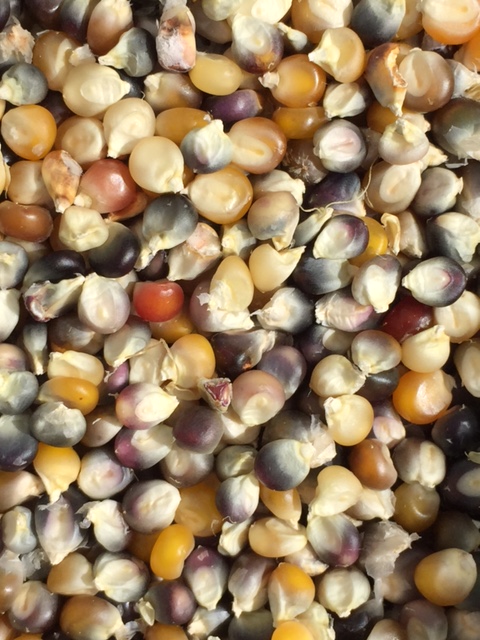
After Several Years, Cherokee Long Ear Seeds Germinated Well
Since the seeds were several years old, I planted them thickly, but
almost every seed germinated and a few weeks later, I thinned seedlings to allow ample growing room.  On September 24th, I pulled a few ears to check maturity and found the popcorn to be nicely germinated with rows of beautifully colored kernels.  Since popcorn dries on the ear before shelling, I left the majority of the crop standing in the field until early October, when I harvested 74 ears.
Colorful Popcorn Cobs Make Great Fire Starters
After the popcorn dried for a few weeks in well-ventilated space, I tested a small amount to be sure the kernels would pop and then shelled the ears.  Impressed by the 4 1/2 pound yield and the delicious flavor, I vowed to grow Cherokee Long Ear every year.  Now that I have plenty of seeds to plant next year and enough to share, I wonder if I can entice my brother to pull out his special popcorn pot?  If he scorches the Cherokee Long Ear, I will not complain.  Heck, I'll even rent a couple of old Disney movies to sweeten the deal.

If you love popcorn and want to enjoy a special treat, seek out heirloom varieties at local farmer's markets or plan to grow your own next year.  I use the following ingredients to add flavor to popped corn, but the instructions for popping are Dale's recipe.

Dale's Sunday Evening Popcorn

In a large pot with a long handle and covered lid, add about 1 tablespoon vegetable oil.  Heat over medium high heat until oil coats bottom of pot.  Add 2 ounces popcorn kernels and shake pot to combine kernels and oil.  Place lid on pot.  Shake vigorously over heat until kernels begin to pop.  Continue shaking pop to allow unpopped kernels to settle to bottom.  To avoid scorching, do not allow popcorn to sit idle while popping.  (Unless you like it that way!)  Occasionally, slightly move the lid to one side to allow a bit of air to enter the pot.  This helps more kernels to pop successfully, but take care to prevent popping kernels from escaping the pot.  When popping slows, remove the pot from heat and pour popcorn into serving bowls.  Add a light sprinkling of salt and enjoy.

Fresh Herbs Add Flavor and Nutritional Punch

Fresh Herb Topping
Snip a combination of fresh herbs you enjoy.  I use basil, thyme, rosemary, borage, oregano, parsley, chives and sage.  Strip the leaves from woody stems like thyme and rosemary.  Using a large chef's knife, chop herbs until they are finely chopped and combined.  Yield should be about 2 tablespoons.  
In a small bowl, combine herbs with about 1 tablespoon grapeseed oil.
Toss hot popcorn with herb mixture and serve immediately.

Cheesy Pepper Topping
Toss hot popcorn with about 2 tablespoons finely grated Parmesan cheese to combine.  Top with a light sprinkling of red pepper flakes.  Serve and enjoy.


Herb topping on left, Cheesy Pepper on Right